Showing posts with label HotDocs2011. Show all posts

Friday, 10 June 2011

Hot Docs 2011 - Short Cuts #7


Finally...My final post on this year's Hot Docs festival...


Love Arranged (2011 - Soniya Kirpalani) - The concept of an "arranged" marriage may seem completely strange to some people, but it depends on your approach. For the two young but modern women who are the focus of Kirpalani's hour-long documentary, an arranged marriage (or at least the process of being presented possible suitors) can be viewed as less of an emotional minefield than the dating scene and much more efficient at pruning out the dregs to find the safe, eligible candidates. One of the two is focused on her business and her partying with friends while the other is much more quiet, reflective and logical. They both find that there is still a great deal of "old ways" thinking in current day India (regarding castes, lightness of skin colour, etc.), but decide to push through to see what awaits them. Even though the film only has two focus people, it really could have used some tightening up (in particular when it came to the self-involved women's own problems and ideas), but also could have benefited from further expansion of wider issues, historical reasons for the process and other modern viewpoints.


The Lumberfros (2011 - Stephanie Lanthier) - The brush cutters of Abitibi (in northern Quebec) lead pretty simple lives - cut during the day, back to the barrack-like trailers at night. Repeat. They are each given specific parcels of land from which they need to clear undergrowth to allow easier access for lumber cutting and use heavy hand-held motorized tools through their long working days. It may not sound like a thrill-a-minute experience watching them and initially I thought the same thing, but the film grows on you...Specifically because of the people. The term "lumberfros" actually designates foreign workers who take on these jobs and we meet several of them from Africa, Eastern Europe and Asia. They all have interesting stories and views on the work and strangely mix well with the Quebecois old timers (whose stories are equally interesting). The boisterous young African with the infectious laugh has big life plans, but many of the other men are content just to have work to support their families back in the city (typically in Montreal). A far better film than I had any right to expect and an interesting slice of life I had no idea existed.


The Chocolate Farmer (2011 - Rohan Fernando) - Through the life of one cocoa bean farmer in Belize and his large family (the number of children he has is easily into the double figures), this National Film Board of Canada feature shows how the encroaching culture of the "Western" world is changing long held ways of life. The farmer loves his work - in particular he loves his forest and the ability to spend so much time with nature every day. His kids aren't quite as interested, though, as he tries to get his sons to follow him and works on marrying off his daughters. It's hard to choose the most interesting aspects of this fine film - watching the choices of his kids as they realize there's a whole other world out there or learning the secrets of a rainforest farmer.

Thursday, 9 June 2011

Hot Docs 2011 - Short Cuts #6


Bury The Hatchet (2011 - Aaron Walker) - I've been to New Orleans twice (though not since Katrina) and love their approach towards ensuring their mix of cultures is less of a bland "melting pot" and more a tasty gumbo. One such example is the Indian Big Chief during Mardi Gras - a tribute to the Native Americans who helped runaway slaves. Over several years, Walker's film follows several tribe leaders through their annual preparations for the big day (mostly via the creation and donning of their wondrous costumes of brilliant coloured feathers and sparkles), their tussles with local police, other leaders and tribes and, of course, Katrina. Even with an Interstate running right over their old parade route, the chiefs maintain their traditions and ensure they get passed down through to the next generation. As the chiefs strut their stuff in these huge costumes, you can't help but be reminded of a peacock proudly displaying its tail. They may seem boastful as they talk of their costume designing, sewing, singing and songwriting skills, but the pride comes from a deep respect of their heritage. If you've ever wondered what a flagboy is, they will be glad to tell you and provide even further education on their living breathing culture. And the music is fantastic.


Gnarr (2010 - Gaukur Ulfarsson) - What happens when a comedian starts up his own political party and enters them into an election? In North America, it typically garners some good headlines, a fistful of jokes and a few well-targeted potshots at current policies and leaders. But in Iceland, well, it ends up being a different story...As Jon Gnarr and his "Best Party" (friends and all manner of artists - including a former member of The Sugarcubes) mount their campaign in the mayoral race in Reykjavik they actually start making inroads and begin to gather support. They never waiver from their stated goals (including making sure the zoo gets a polar bear) and it seems to be an effective strategy against the overly serious "professional" politicians. As much fun as some of the film ends up being, it never really explores why the polls start to favour The Best Party nor does it look at the downside of running this kind of race. It's a bit of a frustrating film in that you are continually waiting for it to start, to get at the heart of something...anything. Entertaining to a point - or rather, entertaining without a point.


The Castle (2011 - Massimo D'Anolfi, Martina Parenti) - A completely observational film that looks behind the scenes at Milan's International Airport, "The Castle" may occasionally be slow moving, but it's rarely boring. Partially that's due to some lovely cinematography and interesting choices of shots and framing and partially it's because you get to be a fly on the wall as numerous interesting items are examined before being let into the country. Of most interest, though, are the human beings trying to get into the country. The drug smugglers, the refugees and the simple tourists all need to pass through what seems to be a phalanx of experienced customs agents and their probing questions. It's apparent that sometimes people get stuck in the airport as well - as evidenced by the one old lady that appears to cook and clean in the public washroom. Being strictly observational, the film doens't have any narration to lead you from one situation to another or explain what eventually happens to several of these people. It's not really required though - the film easily makes its own statements about why many people take chances to get to another country other than their homeland and the strange and sad stories that lie behind them.

Sunday, 5 June 2011

Hot Docs 2011 - Short Cuts #5


Hot Coffee (2011 - Susan Saladoff) - Remember that "crazy" old lady that sued McDonald's because the hot coffee she spilled in her own lap was too hot? What was the first thing you thought when you heard that she won? Before you answer, did you ever see the actual injuries she sustained? Or really hear the full story? Saladoff's film covers not only the details of this case and horrific damage caused to Stella Liebeck (I've rarely seen so many people turn away from the screen in unison as when they showed photos of her burned and charred flesh), but also shows 3 other stories where the real details of the cases may have been obscured by those who didn't want them coming to light. What resulted from some of these poorly covered cases was an easy time of convincing the American public that the time was right for "Tort Reform" - after all, was it fair that these corporations were getting robbed in court by frivolour cases that were wasting tax dollars? If Saladoff's film leans perhaps a bit heavily to one side of the general argument, it makes some extraordinarily effective points about how big business used (and does to this day) its heft to ensure that it controls the court of public opinion and has it cater to their own whims.


Resurrect Dead: The Mystery Of The Toynbee Tiles (2011 - Jon Foy) - A mystery akin to Fincher's "Zodiac" in the way its twists and turns flow down many different threads and in how its main detective becomes completely immersed and obsessive about his quest, Jon Foy's first film tracks his friend's investigation into the Toynbee Tiles - a set of tiles found throughout the Eastern U.S. (and even South America) spelling out cryptic messages referring to Kubrick's 2001, the dead being resurrected and other seemingly disparate things. As they search via the Internet and follow up leads here, there and everywhere, it's the search that becomes fascinating and not really the mystery itself. The various dead ends and odd theories that arise are far more interesting and fortunately Foy recognizes this and gives each its due. Unlike Zodiac's protagonist, though, there's a point where the sleuths looking for the tiles origins are able to stop and let go - and it's a wonderful and very human moment.


Recessionize For Fun And Profit! (2010 - Jamie Kastner) - The secondary title of Kastner's film states "15 Simple Steps!" and refers to the 15 sections into which his 60 minute Michael Moore-esque jaunt of a doc is broken. And "broken" is a pretty apt description. It's supposed to be a tongue-in-cheek look at the various ways people retool their businesses during tough times to continue to make money (from German hookers offering "green" discounts to classes teaching young children the joys of capitalism), but it comes across as condescending, smug and quite lacking in anything to say. At least it's not dull, though, since it does feature some occasionally interesting people and ideas (some good and some so very not good) and switches gears and stories every 3 to 4 minutes. Unfortunately, Kastner inserts himself into the movie and though he tries, he doesn't even have Moore's sense of humour (which admittedly isn't exactly finely tuned). I've tired of Moore by this point and find him just as bad as the far Right fear-mongers he targets, but at least I get his points (whether I agree or not). Kastner just comes across as thinking he is better than essentially everyone else in the film without showing any just cause.

Tuesday, 31 May 2011

Hot Docs 2011 - "Wiebo's War"


Typically, the best documentaries are the ones that make you look at something from a different angle, approach a situation or person in a way you never expected and even further educate you on a topic that you thought you already knew. For example, if you're Canadian, you may think you know the story of Wiebo Ludwig. If the name rings a bell or two, it is more than likely the warning kind that signals "crackpot". Director David York's current day look at the man, his closed community and the history of his battles with the oil companies drilling near his land may not completely change your view of Wiebo, but it might give you some insight into some of his actions.

Some background first...Ludwig was implicated in several oil pipeline bombings in Alberta and B.C. in the late 90s and involved in the shooting death of a young teenage girl on his property. He was charged and found guilty on several counts of vandalism that related to the explosions and served close to 2 years in prison before being released and allowed to return to his community's compound. The community is a devout Christian one that he has built up with several families and is mostly self-sufficient which allows them to stay insulated - apart from the occasional trip to town - from the rest of society. Of course, given that oil production is a big part of the economic engine in this region, many people weren't exactly happy with Wiebo's alleged involvement with those bombings and he and his family weren't overly welcomed in town. One night in 1999, a group of teenagers went joyriding on his property and before you could say "stupid prank gone wrong", a young girl was dead. As reported at the time, Wiebo came across as an eco-terrorist who had a borderline cult deep in the backwoods of Northern Alberta backing him up.


With a new series of bombings beginning in 2008, York brought his cameras into Ludwig's compound to attempt to get a better look at their secluded life and delve into both the new and old oil company issues. It doesn't appear that it will be a smooth ride at the outset, though, as York is questioned by Wiebo and his sons about his atheism: "What gives you the right to deny the existence of God?" asks one of them. This early going may not help change viewers' minds about Ludwig's apparent fundamentalist religious mindset, but as York seems to win their trust, religion recedes into the background during the rest of the film. Let me be clear: any intimations of Ludwig and his family being "crackpots" is NOT based on their specific religious views, but strictly on their reclusiveness combined with what was termed to be an extreme response to their fears of oil exploration.

Here's the thing though...Their fears end up being completely and wholly realized. Shortly after the initial drillings, sour gas leaks near their property were the likely causes of several illnesses in their families, dozens of miscarriages among the animals and 5 separate miscarriages by Wiebo's own daughters and daughters-in-law. In one absolutely devastating moment, home footage shows the family's funeral of a still born baby and the burial they give it. It is shocking, gruesome and deeply disturbing (I rarely turn away from images on the screen, but I couldn't handle this one for much more than a few seconds). Two days after that footage was shot several bombings (the ones Ludwig was eventually sentenced for) occurred at oil facilities. Though it could also be said that the footage exploits that particular tragedy, York has by this point put together (using current day footage as well as home documents from a decade previous) an interesting portrait of the community - the young women seem wonderfully sweet, they all provide for themselves and they appear to be quite happy. Combine this with numerous other facts about the case that never surfaced to the general population (e.g. the RCMP actually purposely staging an explosion as a means of accusing Ludwig to find out more information, etc.) and you begin to see why Ludwig is no big fan of oil drilling or the government. The news at the end of the film that new drilling is about to begin right near the community's water supply again is - especially as we hear Ludwig's tearful declaration to his family that they must endure - heartbreaking.

Nothing excuses many of Ludwig's actions. Whatever danger he and his family may have thought they were in from the joy riding teenagers, someone pulled that trigger and killed a young girl. As well, the bombings of private property were not only obviously illegal, but dangerous to many innocent people. After watching "Wiebo's War", I haven't changed my opinions on his actions or beliefs, but I'd like to think I've gained a better understanding of his point of view. Certainly the sign of a terrific documentary.

Monday, 23 May 2011

Hot Docs 2011 - "The Guantanamo Trap"


"The Guantanamo Trap" signals early on (with some rather poorly intoned narration) that it has a bias to it. Hell, it's title alone gives that away. Fortunately it's strength is that it mostly tucks that bias away when the people are talking - in particular, when the person who wrote the "torture memo" (the letter that suggested many "enhanced interrogation techniques" should be used at Guantanamo) lays out her views.

Not that you need to be completely even-handed when discussing torture, but it's quite fascinating to hear Diane Beaver (appointed legal advisor to the camp command at Guantanamo in early 2002) talk about why she wrote that initial memo and why she does not believe that any of those techniques bordered on torture (by what she terms as "any definition" of the word you'd care to name). The film itself is quite careful to never explicitly state that any of these methods are actually torture, but it's hard to escape that conclusion when you hear people who have experienced it talk to the camera about it.

Murat Kurnaz is first up. Kurnaz, a German-born Turkish National, was picked up in 2002 and eventually fed into Guantanamo as he was under suspicion of being part of the worldwide al-Qaida network. He was left, without charges, in Guantanamo and suffered through 25 hour long interrogations, no food for days at a time, humiliation and other such tactics for a period of 5 years. Turns out there was no shred of real evidence against him. Rumours and speculation plus being in the wrong place at the wrong time (a trip to Pakistan to immerse himself in Islam) sealed his fate. One of the German al-Qaida cells had apparently been a major part of 9/11, so when they heard things like Kurnaz had condoned the attacks (he was "said to have" anyway), had always wanted to fight and had bought a combat suit and boots, he was a prime target (much of that information was learned from his mother). His blank expressionless face as he describes his lengthy stay speaks volumes - he had essentially given up life while incarcerated.


Michael Diaz was also at Guantanamo. In his case, they actually had him cold on his crime. He leaked the names of the prisoners at Guantanamo - information he knew because he was a judge advocate for the Navy and stationed at Guantanamo. His job at the facility was to ensure that another Abu Ghraib did not occur and that they treat the prisoners humanely. Clearly, he says, the people there were not the "worst of the worst" and that many were actually there because they were in the wrong place at the wrong time (including Kurnaz). He saw conditions he thought were wrong and against the law, but realized feeding it up the management chain would result in nothing. So, after seeing a plea from a human rights lawyer to find the names of these individuals, he decided to send them to her - he couldn't stand to see these conditions and knew this was his only chance to help. When this lawyer received the info, she turned it over to the military police...And thus Diaz was caught. Though he didn't go to Guantanamo, he served 6 months in jail and after being on the receiving end of similar tactics that were used at his old base, he realized that Guantanamo didn't invent these interrogation methods - they learned many of them directly from their country's own prisons.

And then there's the Spanish lawyer (Gonzalo Boye) who is trying to bring George W. Bush and Donald Rumsfeld to some form of justice. He believes that Kurnaz's testimony can help implicate Beaver who will then roll over on her bosses (in reality, not an insane plan - Beaver was indeed hung out to dry by her superiors). He has also done time in a jail where certain tactics were applied to him in order to coax out information. He spent almost 8 years in prison for a role in a terrorist kidnapping (which he denies) and was tortured by Spanish police. He's not the most trustworthy figure, seems to have his own personal agenda and doesn't even seem to notice the irony of bringing Kurnaz to a bullfight (the movie is not subtle about comparing Kurnaz to the bull being stabbed to death). His life, however, has been profoundly impacted by torture.

It's fascinating enough to listen to these people's accounts, but the film goes a step further by juxtaposing their comments with a set of interviews with Diane Beaver. Though she never seems to address any of the issues of innocent people being held in Guantanamo or how she can possibly consider the actual implementation of these interrogation techniques as not even being close to torture, she comes across as a truly honest and thoughtful person. She really feels that she did what she needed to do for her country - at the time there was concern over another imminent attack and that any details the prisoners had might be of use. Their standard line of questioning (plus sleep deprivation and solitude) wasn't as effective as they'd hoped, so the memo was created in order to provide her superiors with legal advice on what were acceptable (and much more "aggressive") methods. It was then out of her hands as to which methods they chose and how they actually implemented them (among the ones considered were: "positions of stress", use of individual phobias, removal of clothing and several other techniques), but she's positive that no one ever over-stepped their boundaries and that torture was not committed within the walls of Gitmo. She also seems pretty positive about the prisoners too - she views Kurnaz as a "bad guy" who was associated with some of the worst terrorists around. Wrong place at the wrong time? "That just doesn't wash" she says.

She's erudite, genuine and seems a pleasant sort, but there's additional back story to her life that certainly indicates a less than smooth journey for her. Her current struggles to get her own doggy daycare facility opened provide a complete picture of a woman determined to push through. There's little overt political talk in the film, but at one point she uses the old party talking point that the prisoners in Guantanamo received better health care than the citizens of the U.S. (her family members at her backyard BBQ nod and agree). That's an astounding statement coming from her...

The film shows you these 4 different people with widely different backgrounds who have all been, in one way or another, affected strongly by torture and possibly going through a variety of rationalizations for their actions in the past. Director Thomas Wallner is effective at using news reel and file footage of the camp as well as terrorist incidents (9/11 obviously, but also an astonishing moment captured during the terrorist bombings of trains in Madrid), but also captures some current day footage of these people's new surroundings (Diaz in Times Square, Beaver in her small community, Kurnaz riding is bike, Boye driving through Madrid, etc.) that opens the movie up and shows them trying to interact with the rest of the world.

It's a fascinating study of torture and its wide ranging effects. It never completely delves into black and white statements about the right and wrong of any of the characters' actions and thus becomes, even with its own biases, a healthy jumping off point for discussion.

Sunday, 15 May 2011

Hot Docs 2011 - Short Cuts #4


Dragonslayer (2011 - Tristan Patterson) - Winner of this year's Best International feature at Hot Docs, Patterson's debut feature is in many ways a simple film - it follows skateboarder Skreech through several weeks of skating, hanging out, travelling and living a hand to mouth existence. It's much more than that though. The well deserved accolades the film is receiving (Sundance had praise for it too) come from the way it tells its story, which uses a fractured timeline and slides effortlessly between lovely cinematography and hand-held shakiness, as well as the full picture it gives of Skreech's life. Broken down into 11 different sections (each numbered), we follow the skatepunk through various empty backyard pools in California to numerous minor skateboard contests on the West Coast and all the way to Denmark while occasionally side stepping to spend time with his baby son, his new girlfriend and a lot of alcohol and weed. He's not the most sympathetic of main characters, but is still somewhat charming at times and you can't help but hope he finds his way. The sections focusing on Skreech and his girlfriend sometimes have a bit of a feel of a low-budget Indie film (though a well executed and shot one) and if they managed to capture and frame these shots "on the fly", it really is a remarkable achievement. The craft of the film really accentuates what must be a blurry day to day existence.


Mighty Jerome (2010 - Charles Officer) - Using a completely different set of aesthetic and story-telling choices (black and white cinematography, news footage, recreations, etc.), "Mighty Jerome" is equally as good as the prize winning "Dragonslayer" at conveying a sense of the life of its subject. In this case it's Harry Jerome, a Canadian track and field star from the 60s who held world records in the sprint and was a flawed yet fascinating individual. Though setting his first world record at 19, he seemed to battle negative press for the entirety of his career (even when he had suffered major injuries and staged an amazing comeback). He also ran into a variety of racism while at school in the U.S. and also back home in his native Canada (as the film points out, the more polite racism of Canada - ie. typically not as overt as what Jerome encountered south of the border - was sometimes much worse). The film meshes present day interviews with recreated scenes from his childhood and young adult life (when he met and wooed his caucasian wife) and loads of archival competition and interview footage. By keeping the B&W look to the entire film, Officer not only maintains a consistency across the narrative, but creates a superb looking documentary about a man who was certainly more than a sports hero (his name lives on in the form of awards and scholarships for outstanding black Canadian youth).


El Bulli: Cooking In Progress (2010 - Gereon Wetzel) - Ferran Adria is a controversial world-renowned chef known for creating odd combinations of foods and "deconstructing" the art of cooking. His famous restaurant "El Bulli" (a 5 time winner of Restaurant Magazine's best restaurant in the world award) provides more than just a meal to its patrons (who have to wait literally years for a booking), but a sensory experience. It's about more than just the taste, but the feel, the texture, the smell and the presentation. The film follows Adria and his chefs during one season, starting at the point when they have closed their restaurant for several months while they move everything into their lab. They spend months breaking down individual food items and combining them together to derive new sensations. After the experimenting comes the difficult task of building a new menu - a set of over 30 individual dishes that link from one to the other to provide the full journey. There are some great moments captured (particularly later in the film as they prepare for the opening night), but due to the numerous paths their experiments take them down, I would have preferred either some narration or separate interview segments to give us a fuller story of what they were attempting, what worked and what failed. I hate to ask for a conventional film to document a very unconventional chef and method of cooking, but since I actually wanted to know more about the subject itself, I needed something a bit different than straight observational documenting.

Saturday, 14 May 2011

Hot Docs 2011 - Short Cuts #3


St-Henri The 26th Of August (2011 - Shannon Walsh) - As a kid growing up on the South Shore of Montreal, the only part of "the big city" I was familiar with was the downtown core which contained the big department stores. When I began attending post-secondary school in downtown Montreal, I used to get lifts into the city with my Dad and every day we would drive through the neighbourhood of St-Henri - an area that is surrounded by the Lachine Canal and expressways. I found it a fascinating and somewhat sad part of town - it seemed to be filled with huge abandoned factories (all with their windows smashed out), but had lovely bike paths along the canal and promises of condos, coffee shops and everything the young urban professional wanted. Watching Walsh's single day view of the area (filmed by 16 different filmmakers), I can see that certainly some of those promises were kept, but many more were broken. Cutting between several different subjects, the film gives us wide coverage of the spectrum of St-Henri - the nationalities, the age ranges, the working classes - and a feeling of what it might be like living in the community. It's not always pretty, but seeing so many slices in a mere 90 minutes (even though you never get a real strong attachment to any of the characters) reminded me how fascinating St-Henri was. The film is a tribute to the 1962 documentary (by Hubert Aquin) "St-Henri The 5th Of September".


45365 (2009 - Bill Ross IV, Turner Ross) - Staying on a similar tack as the above, the Ross brothers 2009 film covers about a 7 month time span within the confines of the 45365 zip code in Ohio. The brothers hometown of Sydney is within that virtual border and may explain the access they had to some of these people's lives since it's just so very intimate at times. Though filmed over a much longer time period, it shares with "St-Henri" the desire to cover the breadth of its subject - from top to bottom. "45365" pulls off something remarkable though - fully fledged characters that surprise you, disappoint you and engage you while simply going about their lives. And it's all done with some absolutely gorgeous camerawork. Shots are artfully framed whenever possible and stunning cinematography is pulled off seemingly with little effort. A truly wonderful film and little surprise that Roger Ebert picked it for his Ebertfest this year.


Abendland (2011 - Nikolaus Geyrhalter) - And if you haven't had enough cinema verite focusing on specific environments and the people who live in them, "Abendland" takes things one step further. Covering far more ground (and with much less specific focus), Geyrhalter's film segues through different parts of Europe at night. Border patrols in Spain, Oktoberfest revelers, a massive crowd of rave dancers, a crematorium and an old folks home all roll across the screen in this mesmerizing and beautiful film that, even though it sometimes seems to flow from one random scene to another, gives a strong sense that Europe after dark is a lonely place and quite disconnected. Geyrhalter uses every inch of the screen to create his visuals and you can't help but feel that he had many of them in mind before he even shot them. Filmed over a couple of years, "Abendland" brings you to some places that you either never thought you would see or didn't even know existed. If its overall message isn't completely sharp, it'll leave you with memorable images and the feeling that you need to go have a conversation with someone and connect.

Monday, 9 May 2011

Hot Docs 2011 - Short Cuts #2


Matchmaking Mayor (2011 - Erika Hnikova) - Zemplinske Hamre is not atypical amongst its fellow Slovak villages - all are suffering from an elderly population that is dying off and a younger one that is slow to couple itself off in order to create new generations. What does make Zemplinske Hamre stand apart is a mayor who won't stay quiet about what he sees as upcoming negative population growth - so much so that he broadcasts over the village loudpseakers via his daily addresses that the town's singles need to shape up or their culture will be lost. He offers bonuses for those who procreate, but eventually decides to try to create a big party for all the singles where they can find their love connections. His singular focus is a bit off-putting for some villagers, but he manages to put on his party. But will anyone show up? Though occasionally funny and touching in spots, the film overall plays like an epitaph for the smaller Slovak towns and their lifestyle. Partially due to the nature of humans not being able to save themselves from themselves, but also because of the tough economic times and an overall lack of joy present in the villagers' lives. The filmmakers follow several different people in the days leading up to the party, but never quite get any in-depth profiles of these citizens and don't really get much chance to dig for the root of the issue. Still, it's more than little heart-breaking at times.


Battle For Barking (2010 - Laura Fairrie) - If you have any interest at all in British politics, you've likely heard of the BNP (British National Party) - a bunch of (IMO) racist opportunists looking to kick all immigrants out of "their" country by placing blame for pretty much all of the country's ills on everyone they don't consider to be true British people. Why study the specifics of complicated issues when you can scapegoat groups you don't understand and try to appeal to the masses' need for quick fix answers? Fairrie's cameras follow BNP leader Nick Griffin and a few of his cronies during their campaign to win a seat in the riding of Barking - a diverse multicultural part of London - while also tailing Labour candidate Margaret Hodge. It's not overly original in its approach (behind the scenes discussions about tactics, person on the street interviews, etc.), but it's very effective as we follow both sides through the slings and arrows of what amounts to a campaign these days. Hodge isn't a perfect representative for the area either (there's some disconnect between her wealth and the lower classes in the area), but she's not taking the BNP's crap lightly. If there was any doubt about the lack of thoughtful consideration the BNP puts into its ideas, you just have to listen to Griffin, his advisors or pretty much any of their backers speak for a few minutes off script. I've no doubt that many of these people have issues, but the scariest thing is to see how many of them are so quick to look for a fall guy that they drop all sense of logic or humanity.


Highway Gospel (2010 - Jaret Belliveau) - I used to be an avid skateboarder back in my teens (not a good one, but an avid one) and loved leafing through issues of Skateboarder magazine looking at all the insane aerials that the Stacy Peraltas and Tony Alvas in California were pulling. Occasionally you'd hear about the slalom dudes and - as you viewed them careening down hillside roads - wonder if they were even crazier than the guys flying out of backyard pools. It turns out they are. Belliveau's film traces two separate Canadian devotees of the sport who are past their prime, getting creaky in the bones and yet still love the speed and thrills of the sport. One manages what is considered the premiere slalom road course race in the world (though he's beyond the point where he can compete due to injuries) and the other manages his own skatepark in Ottawa while still training for a shot at the world championships as he slides past the half-century mark. The two stories never really come together to any great degree, but they both show the spirit of people intoxicated by their passions and willing to sacrifice for them (giving up health and wealth). It definitely made me want to reach for my old board - even if I risked pulling a muscle doing it.

Friday, 6 May 2011

Hot Docs 2011 - Short Cuts #1


I'm running behind on my Hot Docs coverage...Considering they just announced the Award winners today, I'm going to try to catch up with some smaller capsule reviews of many of the films I've crammed in so far.


Superheroes (2011 - Michael Barnett) - The regular average-joe playing at superhero is a bit past its freshness date as a central plot point in fictional film at this point (four films in the past year or so made use of it), but what about in documentaries? You knew there had to be a few "crazies" running around in the dark with their homemade capes, so a feature length film about them sounds like a blast right? Well, yes and no. Barnett's "Superheroes" is at times a fascinating look at a good 20-30 different people who patrol their streets (almost always in a costume with a mask) from all over North America and can be a great deal of fun as we see the different approaches to crime fighting, weapon choices and costume design. It's more than just tinged with sadness, though, as we hear some of these people's back stories and find out why they feel compelled to help protect their neighbourhoods. I found there to be a few too many stories to get completely wrapped up in the individual characters, but there's enough in the film to still penetrate the most robust of defenses. Also, who knew that even superheroes weren't beyond the occasional bit of entrapment?


Hollywood Complex (2010 - Dylan Nelson, Dan Sturman) - No matter how often I have to remind myself that I shouldn't judge other parents in how they choose to raise their own children, occasionally I just can't help it. And "The Hollywood Complex" - which covers the better part of 8 months in an apartment complex for families looking to break their children into television stardom - had me handing down sentences like Judge Judy trying to clear the docket on a Friday afternoon. In many cases, one of the parents stays with the child in a small apartment for the entire period of "pilot season" (when the networks are looking to cast their new shows and regularly look for new faces) while the other stays far away at home. In one somewhat upsetting case, the mother and daughter had been living at the complex for 3 full years (not even going back home to the rest of their family during the summer months) hitting auditions, casting calls and the like - with nary a job to show for it. The film provides some interesting behind the scenes looks at the process, the different types of coaching and training the kids get and a diverse set of opinions by professionals. The most galling are the rah-rah coaches who feed the kids and parents' heads with dreams of fame and fortune when in reality the business is rather unforgiving. There's not a great deal special in the way the film is shot, but it does what it needs to do. The unfortunate thing is that films of this type really need their central characters to be not just people you root for, but ones you feel a connection to in some way. For the most part, all I felt was frustration and even disgust.


Open Secret (2011 - Steve Licktieg) - Director Licktieg turns the camera on himself and his family to tell the story of his upbringing and a little secret about his parents. Can you really call it a secret, though, when everyone knows it? Everyone except Licktieg that is - until his teenage years, he assumed his parents were his parents and he just happened to have been one of those "ooops" babies who popped out years after the couple thought they were finished having kids (hence the slew of much older siblings). Not only did Lickteig discover he was adopted, but that his real mother had been with him the whole time in the form of his "sister". There's some fascinating material to work with here - his real mother was more interested in getting away from the family than really helping raise her son while his grandmother was a controlling and cold caregiver - but unfortunately Licktieg is too close to the subject and as a first time filmmaker (coming from his job at NPR public radio), he never really explores some fundamental questions and occasionally drops into self-pity. It must be difficult to try to rebuild your own idea of who you are and I give him credit for attempting to use the film in that capacity, but "Open Secret" ultimately fails to provide much mystery, answers or sympathy.

Hot Docs 2011 - "The Future Is Now!"


There's something to be said for "talking head" movies. When intelligent people discuss interesting or novel ideas in passionate ways, you don't necessarily need an overall story arc, narrative thrust or cinematic quality to the proceedings - smart people saying smart things can be engaging enough. Certainly none of those other elements would hurt, though, and the addition of them can lead to fascinating viewing. So I had my hopes up for Gary Burns and Jim Brown's latest film "The Future Is Now!". It purported to have a bevy of experts (in fields of architecture, art, evolutionary science, etc.) talking about what the future might have in store for us and how our lives might change. To do this, the film wraps the fictional story of a disconnected cynical man being shown what humanity might achieve as he gets to interview these thought leaders. I bought into this rather odd concept and the claims of "a cinematic voyage through endless future possibilities" partially due to the directors' previous film - the fun and very sharp "Radiant City" - which combined wonderfully staged interviews of urban planners with the story of a suburban family trying to cope with the many pros and cons of living in their neighbourhood. So I expected "The Future Is Now!" to be filled with smart people, clever structural devices and superb filmmaking.

Though I can't blame them for trying something different, the only thing that works are the actual talking heads - and only when they are allowed to go off on their own tangents and aren't forced into answering specific questions. Had they but only filmed these curious thinkers chatting to a single static camera, the film would've been far more thought-provoking. The artificiality of the construct that a Woman Of Tomorrow (a TV news reporter) is able to line up all these people to convince this one cynical guy (dubbed the Man Of Today) that the world has hope finally sinks the film. That's not to say it doesn't occasionally induce a certain amount of percolation of ideas in your brain: the architect Shigeru Ban does pro bono relief work that has far reaching benefits, the author Rivka Galchen briefly mentions the concept of parallel universes spawned every time a decision point is reached, Richard Dawkins sees genetics as "a branch of information technology" and even Jean-Paul Sartre (as the ghost of yesterday) chimes in to point out the logical fallacy of seeing oneself as completely different from everyone else. Whatever inspiration evolves from these moments is constantly undermined by the framing story and its unfortunate proclamations.

The film opens with several person on the street interviews about what their greatest fear is. Most are poorly acted and immediately dilute the desire to really pay attention to what's being said (except for the guy who was concerned about "mystery moisture" - one of the better potential conspiracy theories I've heard of late). The reporter comes across a man who claims not to have any fears because he doesn't think about it much and really has no hope for the future. He simply wants to live out his life without causing too many problems. She's never met anyone like him and convinces him to attend a poetry reading that night to engage with intellectual pursuit and new ideas. He agrees and is brought from one new person to another (though sometimes, like with Ban and Dawkins, the interviews were done with other people and his questions are spliced in). The reporter, as the Woman Of Tomorrow, feels she must convince this man that there is always a future ahead and it holds, if not something better, at least something interesting.

I can't argue with that concept and quite like Galchen's later position that we should "take ludicrous ideas somewhat seriously" if only to find the kernels or truth or beauty contained within them. An example of this is the poet's idea that he wants to write a poem that will be converted to a genetic code for a protein which in turn when created will trigger a new protein in response and therefore "the organism becomes the living embodiment of my poetry". Not much practical benefit, but an interesting nugget to sit back and ponder. It's moments like that which frustrate me most about the film though - it could've followed so many of these flights of fancy down their paths, but always stops short in order to get back to the reporter's job of convincing the central character of the good in humanity. The conversation flow between the two of them just never feels honest and tends to kill any momentum the film had built up. It culminates in some heavy handed preaching by her complete with cuts to school children at play. Does the future not contain any subtlety?

"I have to fight sometimes to keep steering my emotions to the positive" says the Woman Of Tomorrow in her final sermon. A pretty good summation of my feelings about the film.


Thursday, 28 April 2011

Hot Docs 2011 - "Beauty Day"


"Beauty Day" opens with a most decidedly not-beauty moment for Ralph Zavadil (otherwise known as Cap'n Video). As his camera rolls and documents yet another of his solo "stunts" for his cable access show, the jovial Cap'n (looking like David Lee Roth after a week-long bender) launches himself off a high rung on the ladder he's propped up against his fence. The plan is to plunge right into the middle of his tarp covered pool to demonstrate a new way of opening it for the season. As the 14 year-old videotape footage shows, things go horribly wrong - the ladder yields from Ralph's push off, he drops short of the pool and lands square on his neck on the concrete breaking 2 of his cervical vertebrae. "Unfortunately, I didn't think it through all the way" says current day Zavadil - not with any bitterness, sadness or regret in his voice, but with the self-deprecating tone of someone telling a really good story to his buddies. Of course, when you're wearing what appear to be reindeer antlers with multicoloured headlamps on them, you need to make sure you aren't taking yourself too seriously.

So why has director Jay Cheel decided to focus his feature length debut on the star of a decade old cable access show from St. Catharines, Ontario who sounds like a bad impersonator mixing French and Newfoundland accents? You can certainly see the initial appeal - Cap'n Video was a staple of the TV diets of teenagers in St. Catharines in the early 90s (a "Jackass" show before "Jackass" existed) and that failed stunt gave him world wide attention (a "Real TV" segment, Japanese TV, talk shows, etc.). However, there's got to be more than just that, right? You bet there is. As with many of the best documentaries, the people themselves become just as fascinating as the central storyline. By the end of the film, I had not only become somewhat attached to Ralph and his friends and family, but quite disappointed that I couldn't spend more time with them. They are interesting, funny and show a great spirit towards how they live their lives.

By folding in the old video clips from the Cap'n Video shows with present day footage following Zavadil through his daily paces, interviewing him and others about his life and tracking his attempts with his best friend Robert to put together a 20th anniversary show, the film does a tremendous job in slowly pulling us into Zavadil's world. There's no mean-spirited tricks up his sleeve in such stunts as "rooftop tobogganing" or "clothesline skiing" - all his "skits" were about goofy fun and being inventive. Granted, "chocolate covered puppies" was probably not his best idea, but it's easy to see it was simply a lapse in judgement and nothing more. As Robert says "I don't know how much thought he put into these things". He chuckles about this, but actually shows some sadness at missed opportunities - a bit more effort, money and help may have given Cap'n Video more polish and more attention. That's not Zavadil's way though. Since he beat cancer at an early age, his viewpoint has been to live life large and day-to-day. As his father did, he spends his days "just given'r".

There is a strong sense of detail in the film. Cheel (who also snags writer and editor credits) gets acquainted with the environment of these people and focuses his lens on things like Zavadil's Mom's cookie tray or Robert's glass artwork along with, of course, some of Cap'n Video's more interesting gadgets and methods (e.g. using a couple of old VCRs to edit his show). Attention to detail also applies to pretty much every other aspect of the film. Director A.J. Schnack has long campaigned that documentaries shouldn't have to look bland or feel they should sacrifice or skimp on things like cinematography. A trip to a ferris wheel at dusk and a cruise up and down a beach with Cap'n Video and his homemade scooter are proof positive Cheel is solidly in Schnack's camp. They're both gorgeous scenes. Then there's the music: The Talking Heads' propulsive "Thank You For Sending Me An Angel" chugs through the opening credits and a checkerboard of video clips; Triumph's "Hold On" works perfectly as Zavadil's soundtrack as he goes to work (particularly when it increases in volume to make it feel like he's getting lost in the music and his own thoughts); Ohad Benchetrit's (from the terrific band Do Make Say Think as well as Broken Social Scene) original songs and music fit seemlessly into the whole.

It's a temptation to go for the obvious and mention it's a beauty film, but that doesn't do it justice. It's truly a wonderful, detailed and completely engaging character-based story. I can't wait until more people see it.


Hot Doc screenings of "Beauty Day":

Friday April 29th at 6:45PM - Isabel Bader Theatre
Saturday May 7th at 4:15PM - Isabel Bader Theatre


Friday, 22 April 2011

Hot Docs 2011


"...and perhaps best of all, they remind us that there is an audience interested in intelligent conversation."

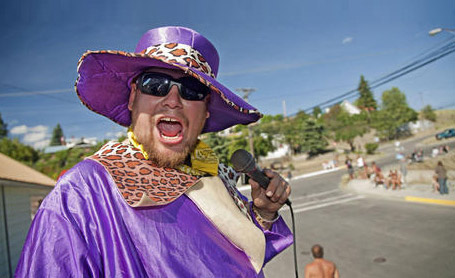
Coming in just shy of cracking the 200 film mark, the stuffed lineup of this year's Hot Docs Film Festival was released a few weeks ago. The quote above is from festival Executive Director Chris MacDonald as he kicked off the Press Conference which announced the headliners, special events, retrospectives and other highlights among the many shorts and features to be screened between April 28th and May 8th in Toronto. The photo above is Cap'n Video engaging in some of that thoughtful debate...

Here's a short preview of this year's festival:


Some of the Main Events

  • Pom Wonderful Presents: The Greatest Movie Ever Sold - Morgan Spurlock's latest film appears to be trying to have things both ways - while purporting to be a close look at product placement in our culture and the seeping influence of advertising, Spurlock actually financed the entire film via the placement of ads within the film. His pitch to advertisers is that the film is about his pitch to advertisers - including them. I expect that it may show some interesting board room discussions and give numerous examples of insidious marketing, but it's going to be an awful tricky line for him to walk. The film is the opening night gala for the festival.


  • Project Nim - Seriously, isn't Nim Chimpsky the best name ever for an animal? Particularly when it's a chimpanzee (wouldn't be quite as great if it applied to a kitty now would it?). James Marsh's newest film (and first documentary since "Man On Wire" after sneaking in one of the Red Riding trilogy films) documents the life of Nim as part of an experiment to see if one of our closest relatives on the evolutionary scale could be raised as a human, take on our characteristics and relate to us. From everything I've read, it sounds fascinating.

  • Conan O'Brien Won't Quit - While O'Brien was in between gigs (and prohibited from appearing on TV), he staged a whirlwind tour to vent his frustrations and his comedy to adoring fans (is Team Coco still a relevant term these days?). The doc promises not only some of the best footage of those live shows, but behind the scenes and reflective interviews.


  • Being Elmo: A Puppeteer's Journey - OK, I'll say it here: Elmo kinda bugs the crap out of me. Don't get me wrong - I love Sesame Street (I watched its first season when I was in Kindergarten) and consider Jim Henson a personal hero, but the bright red, grating-voiced little guy never appealed to me. However, the clip showed at the press conference fits the film's title - it's more a behind the scenes look at puppeteering and a story of the man who controls Elmo. In fact, the 2 minutes were so engaging, that the film is right near the top of my to see list.

  • Magic Trip - Of little interest to me - at this stage anyway - is Alex Gibney's latest venture (with partner Alison Ellwood) which is described as a recreation of Ken Kesey's acid-induced 1964 journey across the U.S. with the Merry Pranksters. It's not that I have no interest in the history or the story, but I can't get overly excited about recreated footage mixed with old audio recordings. Maybe Gibney can pull something interesting out of the idea.


My Picks


  • Abendland - The film's title translates to "The West" and is apparently a visual essay of Europe at night with scenes from crematoriums, TV studios and a variety of different locations. Focusing on the industrialized sections of Europe, I expect gorgeous visuals and odd details meshing together to paint a picture of the good and bad of a modern wealthy culture.

  • The Battle For Barking - As much as I love political documentaries and the chance to see what happens behind those closed doors, this could be a difficult watch as it shows a particularly vicious British campaign from the 2010 federal election in the London borough of Barking. I can barely stomach the North American approach to campaigns ("Fear! Fear!"), but this seems to amp it all up by really playing to racial divides. And yet I'm still drawn to it - the human need to break down complex issues so that they can blame one particular reason (or preferably, one particular group of people) fascinates me.


  • Beauty Day - Jay Cheel's feature length directorial debut focuses on the star of a 90s local cable access show called Cap'n Video and his attempt to put together a 20th anniversary show. It's easy to call Cap'n Video an early version of "Jackass" (he'll do anything for his camera), but there's far more charm to his one man show. I've seen a screener of the film already (so I hope to get a longer review out soon), but I may not see a better film at Hot Docs this year. I was truly sad to have to say goodbye to these people at the end of the film.

  • Beetle Queen Conquers Tokyo - The film with the best title of the festival takes a look at why Japan, more than any other country, has a fascination with insects. While the rest of us typically have a desire to remain as detached from bugs as possible, the Japanese put plastic ones in their Happy Meals. The film works its way backwards through history to trace the roots of this long lasting love affair.


  • The Bully Project - Director Lee Hirsch spends a year in the American education system to paint a picture of bullying in high schools. My guess? It's not a pretty sight.

  • The Future Is Now! - Gary Burns and Jim Brown return with another docu-drama (after their terrific look at the suburbs in 2006's "Radiant City") that follows the Everyman through interviews with different leaders in fields of arts and science to show not only the possibilities of tomorrow, but those of today. The trailer might seem a bit off-putting, but I trust Burns and Brown to weave their themes around the ideas of really interesting people.

  • Gnarr - Comedian Jon Gnarr created The Best Party as a jab at the left and right sides of the political system in Iceland, but he somehow managed to tap into a segment of the population that were tired of only hearing the ends of the political "spectrum". Apparently, a pretty large segment, since Gnarr becomes an actual viable candidate for mayor of Reykjavik.


  • Hot Coffee - Remember that crazy lady who sued MacDonalds over their coffee being too scalding hot? Ha! What a fool, right? Not so fast there bub - there's more to the story and much more to its aftershock effects. The case was essentially tried in the court of public opinion and so many details never made it out. The film submits that a better case of Corporations using the media to distort legal issues against them will likely not be found.

  • Incident By A Bank - A single take 12 minute short recreating a failed bank robbery in Stockholm, this film focuses specifically on the reactions of the bystanders and sounds like it could be a fascinating exercise.

  • Lovable - One of the films being shown in the retrospective series focusing on director Allan Zweig, "Lovable" is his rumination on being single in a culture that implies there's something wrong with you if you are. In order to dig deeper, he interviews many single women to get their own views.


  • The National Parks Project - 52 filmmakers and musicians celebrate Canada Parks centennial year by putting together a composite of this country's gorgeous landscape and the richness of our National Parks. A big screen viewing is a must.

  • A Simple Rhythm - This 52 minute "visually immersive meditation on the beat that binds us draws on music, science, medicine and the cosmos to better understand nature’s irrepressible forces." Sold.


  • Superheroes - After several fictional films about regular everyday people trying to be superheroes, there's now a documentary about them. Scattered across the U.S. and Canada, the vast array of characters and their alter-egos (e.g. Mr. Xtreme) tell us why they take to the streets at night to fight, as best they can, whatever crime they come across. Costume making tips are also handed out liberally.


Special Programs & Events


  • Alan Zweig Retrospective - This year's "Focus On" series will look at the work of Toronto filmmaker Allan Zweig. The only film of his I've seen (and possibly his most famous) is "Vinyl" - a great look at those who obsessively collect and search out specific records (Zweig knows a thing or two himself about this compulsion). His films tend to be personal and include his own thoughts on the subjects at hand, but never (from what I've seen and heard) in any overly self-involved way. Looking forward to finally seeing "Lovable".

  • Made In Italy - Each year the festival chooses a specific country to spotlight and this year Italy gets the nod with a series of 8 new films. My pick is "The Castle" which is a cinema verite look at the behind the scenes work of border security guards at Milan's airport.

  • Workers Of The World - Another series is focused on documentaries looking at the working class from all over the world - their struggles on and off the job and the variety of work humans end up doing - from a Czech Hyundai plant in a small farming community to the closure of a large shipyard in Germany to Panamanian maids and their rich employers to life in Cambodian villages. Even Santa pays a visit.


It all starts on Thursday April 28th. Get your viewing goggles on...