Sunday, 22 April 2012
Coincidental Parallels - "House Of Pleasures" and "The Secret Of The Kells"
Two obviously vastly different films that I recently just happened to watch back to back, "House Of Pleasures" and "The Secret Of The Kells" did not strike me as candidates for sharing anything in common. The first is a beautifully lensed story of prostitutes in turn of the century (19th to 20th) France while the other is an animated tale of one boy's quest to complete a magic book and show that enlightenment is the strongest protection from evil. Yet each one - for different purposes - uses a three way split screen at one point ("House Of Pleasures" uses a four way split - in quadrants, not side by side - in a few sections as well), so you just never know where you might find these little connections between films...
Shinsedai Cinema Festival 2012 - An Early Look
OK, I'll be honest up front - I'm very biased towards the Shinsedai Cinema Festival. My good friend Chris MaGee is one of the founders of the fest (along with Jasper Sharp of Midnight Eye) and I've seen him work his butt off to make the festival not just successful, but relevant. As it prepares for its 4th year (they've announced a chunk of their films which I'll get to below), it's clear Chris and Jasper have grown the reputation of the event each time out and are beginning to attract more and more attention. Chris will be on this year's jury for the Nippon Connection in Frankfurt (the largest Japanese film festival outside of Japan) and filmmakers are starting to ask if they can bring their films to Shinsedai. The mandate for the festival is to expose young, independent filmmakers to a wider audience and the focus has remained on exactly that. Things branch out occasionally - e.g. a wonderful showing of the silent Mizoguchi film "The Water Magician" (complete with a live soundtrack) a few years ago; this year's double bill of Pink Films - but the core of the festival has been about giving the new generation a forum for their films outside of Japan.
Chris has also done me the honour of asking me to be part of the Board of the festival - a role that doesn't exactly tax me at the moment since Chris and Jasper are the drivers and brains of the fest. This year has proven extra challenging due to a location shift away from the lovely Japanese Canadian Cultural Centre to a downtown theatre (The Revue Cinema - one of Toronto's fine repertory theatres), but, as the kids today say, it's all good. With much easier access to the theatre via public transportation and much more engaged PR help, the festival is definitely going to create more of a stir in 2012.
Particularly with the lineup so far announced:
Ringing in Their Ears
Described as an irreverent rock comedy/drama, Yu Irie's "Ringing in Their Ears" kicks off this year's Shinsedai with a mix of fact and fiction. Real-life band Shinsei Kamattechan moves from indie stardom to the majors and the film follows the attempts of their manager to preserve their artistic integrity while also keeping tabs on some of their odd fanbase. Live concert footage is mixed in to what I can only guess will be a wonderfully energetic way to start the fest.
"Ringing in their Ears" screens on Thursday, July 12th at 7:00PM.
Zero Man vs. The Half Virgin
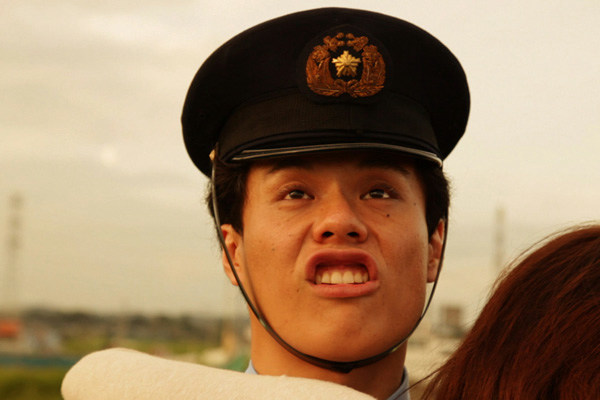
The scriptwriter of two of Takashi Miike's more well-known films ("Ichi the Killer" and "Gozu") and the director of "Tokyo Zombie" have come together to bring us the story of Zero Man - a cop with amnesia who realizes he has the strange gift of being able to see numbers on people's foreheads. The match of scriptwriter and director is a perfect one since they both happen to be the same person - Sakichi Sato. He's also one of the biggest character actors in Japan and plays triple duty by also taking a supporting role in this surreal tale of policeman Sakuragi and his odd ability that only manifests itself when he is aroused. He comes to believe that these numbers indicate the amount of sexual partners each person has had (he sports a zero on his own forehead), but what does the 0.5 mean on the mysterious young woman who attracts him?
"Zero Man vs. The Half Virgin" screens on Friday, July 13th at 9:00PM.
The Naked Summer
Each summer famed butoh dancer Akaji Maro invites professional and amateur dancers to participate in an intensive retreat to study the avant-garde art form. Maro and his students are followed in this documentary through one entire summer as they explore the movements and philosophy of butoh and work towards a final performance out in the countryside.
"The Naked Summer" screens on Saturday, July 14th at 1:30PM.
From the Great White North: Yubari Fanta Special
The Yubari International Fantastic Film Festival takes place every year in Hokkaido (Japan's northern island) and has become one of the most important events for indie Japanese filmmakers. In collaboration with Yubari, Shinsedai presents "From the Great White North: Yubari Fanta Special" - a set of three short films selected with the help of Yubari festival director Yasuhiro Togawa - which captures part of the diverse and slightly skewed spirit of Yubari Fanta. There's the high school girl who has developed her own brand of sexual martial arts in "Hole And Pole", a short documentary entitled "The Student Wrestler" which shows the benefits of social misfits getting out their frustrations through professional wrestling and "Mrs. Akko and Her Husband" which tells the tale of a couple that needs to pull themselves out of their apathetic relationship.
"From the Great White North: Yubari Fanta Special" screens on Saturday, July 14th at 4:30PM.
End Of The Night
After Tamegoro assassinates a married couple, he decides to take their infant son home and raise him. The boy, Akira, ends up being a sociopath which just happens to be the perfect attribute to follow in Tamegoro's footsteps as a hired killer. But what happens when you meet someone who has survived one of your old hits? Director Daisuke Miyazaki (who was the assistant director of Kiyoshi Kurosawa's 2008 film "Tokyo Sonata") gives us "a 1960's Nikkatsu action film filtered through the deadpan aesthetic of Takeshi Kitano". Sounds pretty good to me.
"End Of The Night" screens on Saturday, July 14th at 7:00PM.
Battle Girls & Bondage: A Pink Film Double Bill
Shinsedai Co-programmer and Co-Director Jasper Sharp is somewhat of an expert on Japanese pink films (in fact, he authored the book "Behind the Pink Curtain: The Complete History of Japanese Sex Cinema") and the festival has finally managed to bring a few examples of the genre to Toronto (the first ever theatrical screenings of the genre here). In cooperation with distributor Pink Eiga, "Battle Girls & Bondage: A Pink Film Double Bill" will feature two hour-long examples: "Sexy Battle Girls" and "New Tokyo Decadence: The Slave". It goes without saying that you must be 18 or older to attend this particular event. Though one of the more controversial selections the festival has made, it may also prove to be one of the more surprising.
"Battle Girls & Bondage: A Pink Film Double Bill" screens on Saturday, July 14th at 9:30PM.
Tentsuki
David Lynch and Takashi Miike's names are mentioned as comparison points in Masafumi Yamada's story of a man running from the yakuza who ends up hiding out in a unmapped portion of Kyoto. He finds a job at a construction site and encounters a raft of characters while the tale drifts from comic to haunting.
Tentsuki will screens on Sunday, July 15th at 8:00PM.
You can check out trailers for all these films at the Shinsedai YouTube channel. The final round of films will be announced sometime next month, and tickets and passes for the festival go on sale June 21st. For more information on the fest be sure to visit the Shinsedai Cinema Festival website.
Monday, 16 April 2012
Shame About Ray...And His Hair
"The Attic" - the only directorial bow from the scribe of the quite spiffy "The Killing Kind" - is a mostly entertaining (if slow) psychological horror-ish warning about the evils of controlling parents. Carrie Snodgress stars as Louise, a mousy librarian stuck taking care of her wheelchair-bound father while she pines for a fiancee who disappeared two decades previous. The great Ray Milland plays her Dad (her really awful, cruel Dad) and I didn't even recognize him initially. His weathered and bald dome seen above actually reminded me much more of my own Dad (my really fantastic, kind Dad). As he continually puts Louise down, he also negates anything good that she may have done in her life and places far too many demands on her. It's wearying watching her slouch through life and Snodgress does an admirable job in bringing that across in her character (except for perhaps a few too many "she's a bit off her rocker" scenes).
So given all that, you wouldn't really expect a laugh out loud moment during a particularly revelatory moment for Louise would you? As we close in on the resolutions of several plot points, though, there's a humdinger of an unintentional howler. The film has a bit of a 1980's made-for-TV feel, but is mostly quite competently made - except, that is, for a moment of confrontation on top of a hill late in the picture. Louise has wheeled her father up to the peak as part of his regular Sunday morning stroll and, as one thing leads to another (and since the film is good enough not to spoil, I won't say what leads to what), her Dad tumbles down the hill - suddenly with a full head of hair...
And dark brown hair at that (in contrast to the little bits of grey seen in the screenshot at the top of the post which occurs only moments before the ass over tea kettle trip down the hill)! I totally get why they needed a stunt man since I doubt that Milland (who was 75 years-old at the time and appearing in one of his last feature films) was going to tuck and roll through branches and rocks just to get the shot. But could they not afford a little makeup? Maybe one of them bald "wigs"? Perhaps at least some creative editing?
Then again, I guess I wouldn't have had my belly-laugh for the evening...
Wednesday, 28 March 2012
Tuesday, 27 March 2012
Blind Spot #3 - "The Tin Drum" & "Stand By Me"
I knew when I started doubling up on these Blind Spot entries that some of the relationships between the films might only be tenuous at best. I also figured that might be half the fun - trying to tease out parallels or commonalities where I hadn't even realized they might exist. For this month's pairing I started with a pretty basic bond: both films have children as their central characters. Nothing more. I'll admit it, I was reaching. But you never know what will spring up upon closer reflection.
In the case of the 1979 winner of both the Academy Award for Best Foreign Film and the Cannes Palme D'Or (shared with "Apocalypse Now"), it's central character is really only a child for a portion of the film. "The Tin Drum" follows the first 20 years of the life of Oskar from his birth (which we get to see from Oskar's point of view) through to the end of WWII. After turning three years old, he decides he doesn't want to grow anymore and throws himself down a set of stairs. He physically stops growing after this and becomes very attached to his tin drum which he plays so often it requires regular replacing due to the holes he pounds into it. He refuses to give it up just as he refuses to grow into an adult - a terribly hypocritical creature (from everything he has witnessed so far) that he would prefer not to become.
The four adventure seekers in Rob Reiner's 1986 film "Stand By Me" are also trying to hold back their forward momentum towards adulthood. Sure they smoke, talk about girls and are venturing out to locate a dead body before anyone else, but upon closer inspection each boy is concerned about the transition from elementary school into the big bad world of middle school. They fear the loss of their friendship, the challenges ahead and, similarly to Oskar, becoming adults. There aren't a whole lot of good adult or parental role models in either film so there's a strong pull to stay in childhood and stave off the moral swamp that appears to be the natural habitat of grown-ups. Both films move swiftly through their stories due to being structured as a series of scenes - Oskar's across 20 years and the 4 boys over one single weekend at the end of a 1950s summer - that build towards character changes and moments of self-realization.
Oskar passes through a wide variety of hurdles - bullying, first love betrayal, sex, knowing about his mother's affair with his uncle - and continues to drum away refusing to join the ranks of the adults. And given what he sees all around him, why would he? In particular (and talk about hurdles) the creeping influence of Nazism pulls in his father while his uncle remains on the outside. The story takes place in the "free city" of Danzig (now known as Gdansk) which was neither Polish nor German at the time (due to terms from the treaty of Versailles) and though there has always been a good standing relationship between Oskar's father, uncle and mother (almost an agreement that the affair could go on), things begin to splinter. Oskar's mother retreats, his uncle is marginalized and Oskar eventually joins a troupe of travelling entertainers (he's 18 or 19 by this time, but still no taller).
The boys of "Stand By Me" pass through their own set of obstacles as they journey alongside the rail tracks to the location where they think a dead body may be found. It's a far more compressed timeline than Oskar's story of course, but they all have their own trials and tribulations to work through as their bonds are challenged, they reflect on their parents lack of support, and wonder how their lives will change when school starts up again. Gordie can't even get his parents' attention since his older brother died (played by John Cusack in flashbacks) and can't see the point of it all. Fortunately, he has friends to try to convince him otherwise - in particular Chris (played by River Phoenix in easily the best performance of the film) who insists that Gordie will be the one to escape from their small town and make it as a writer.
While "Stand By Me" works in a gentle nostalgic tone within its episodic structure, "The Tin Drum" prefers to play in more surreal waters. This meshes well with the huge wide eyes of Oskar (played by 12 year old David Bennent) and the entire lead up to WWII. One of the best scenes in the film is an early Nazi rally in Danzig that pulls in the whole town. The local leader quips that the Germans had to teach the Poles to read in the first place (which elicits a chuckle from a small boy - a subtle way of showing the indoctrination of the young) and there seems to be little resistance to ideas being thrown out. As the speeches wind down, the fanfares start and the assembled crowd waits for a guest of honour (a ranking official in the party), Oskar slips under a set of bleachers and starts to loudly play his drum. This has the effect of slowly changing the band's music to a waltz and the crowd shifts from giving the one armed salute to dancing with each other and blocking the path of the arrived guest of honour. The film plays many of these scenes broadly to get its satire across and becomes very effective at it after a rather fractured first 10-15 minutes (it may take a while to get your bearings as you piece together the location and character relationships). It's none too subtle sometimes as when Oskar talks to a circus performer about his ability to shatter glass with his screams:
"I prefer to be a member of the audience and let my little art flower in secret"
"Our kind must never sit in the audience. Our kind must perform and run the show, or it's the others that will run us. And the others are coming..."
As Oskar tries to find his way, he wonders if he'll ever reach a point where he can comfortably be himself and have others accept that.
"Stand By Me" plays things much more straightforwardly. Though I'll admit that it didn't work completely for me, the film does have a lot of charm to it and easily transports me back to my own "off in the woods" adventures when I was a boy. That freedom to explore and take risks is integral to the film and some of its best scenes. The crossing of the long train bridge (and subsequent arrival of a train as they reach the midpoint) is the most recognized scene for good reason. There's enough involvement with all 4 of the kids by this point, so you've been caught up in their adventure. As well, let's face it, you can't help but imagine yourself on that same bridge and wonder if you could out run that same train...The development of the characters is handled well and their back stories come up in natural fashions. The film stops a bit dead in its own tracks whenever it flips to the story of the older bullies who are searching for the same body since there's really nothing of interest in this arc and nothing new in any of the stock bully characters. I can see why they were somewhat necessary in the plot to create that final showdown and tie back to the film's title, but I can't help but wish that the film stayed solely with the kids. Though they aren't always completely interesting as their twelve year old selves (their in-jokes, etc.), at least they feel like very honestly written characters who stay true to their nature and to themselves.
In both films, the central characters not only need someone to believe in, but someone to believe in them.
Saturday, 24 March 2012
Hot Docs 2012
Amidst the usual bevy of clips, images and detailed descriptions, Tuesday's Press Conference for this year's Hot Docs Film Festival (April 26 - May 6) had two other big announcements:
- An experiment to simulcast several movies to different Canadian cinemas at the same time and have a live director Q&A as well.
- Free coffee/espresso for people waiting in rush ticket lines.
OK, that second one may not be quite as impressive (even if it did garner pretty enthusiastic response from the assembled crowd at the Bloor Cinema), but the two items together show why Hot Docs is one of the top film festivals in the world: they go after the big and even risky ideas while always taking into account the attendees and the little details that make an event memorable.
The simulcast events (called "Hot Docs Live") do indeed sound chancy for the organizers, but there's a genuine feeling of excitement from the festival staff that they are bringing the festival to the rest of the country. Those screenings will be announced on March 30th and the broadcast will happen to 50 theatres in Montreal, Ottawa, Calgary, Vancouver and several other cities. Along with their DocIgnite program (please go support the "How To Build A Time Machine" project at the link - we need to hear the full story...), Docs For Schools and their many other programs, Hot Docs has also now set up their base in the newly renovated Bloor Cinema. The press conference was my first visit there and it was suitably impressive - it's smaller inside the theatre, but cozy, comfortable and beautifully put together. Can't wait to see a film projected there.
As for the actual films during the festival, the opening night selection will be "Ai WeiWei: Never Sorry" about the Chinese activist and artist. The film is a first time effort by Alison Klayman and plays twice on the opening night of April 26th. Charlotte Cook, the new director of programming for Hot Docs, calls it a "perfect story of art as a means for change" as Klayman had deep access to follow the artist who, over the last few years, has bridged from being an artistic consultant for the Beijing National Stadium (for the 2008 Olympics) to being arrested for two months by Chinese authorities.
In total, the fest will be providing over 400 screenings of 189 films (chosen from 2085 submissions!) from 51 countries. There's a small drop in the total number of individual films being shown, but an uptick in how many will receive three showings. I've barely skimmed the surface of the extensive list, but a few standouts already:
- The Beaches Of Agnes - Previously reviewed here after seeing it at TIFF in 2008, I'm thrilled Hot Docs is giving this another chance to be seen on the big screen. The wonderful Agnes Varda takes a look back at her own life and career in art (mixing in film, painting and the kitchen sink) in this incredibly charming work. I'm biased because I love the films of her and her late husband Jacques Demy, but I'd find it hard to believe anyone could resist the fantastic creativity on display here. Part of The Documentary Plays Itself program (including other documentaries about films and their filmmakers).
- Beware Of Mr. Baker - To say that Ginger Baker is a might ornery is like saying he's a pretty decent drummer - a huge understatement. Great reviews came out of Sundance for this and it's pretty much my most anticipated since I love him not only as a rock drummer par excellence, but also due to his interest in African rhythms, his work with Bill Laswell and a variety of other projects.
- Bones Brigade: An Autobiography - As far as I'm concerned, Stacy Peralta can continue to document every little piece of minutia regarding the southern California skateboarding and surfing history for his whole career. Both "Dogtown And Z-Boys" and "Riding Giants" were fantastic (in story, execution and style), so I have high hopes for this closer look at the skateboarding team he created which helped launch the massive popularity of the sport.
- Charles Bradley: Soul Of America - You like soul music? Then you're gonna love Charles Bradley. At 62 years old, he's just now breaking through in the music business after building a wealth of hard won experience. Likely a crowd pleasing doc of the best kind.
- Detropia - Hurt more than most urban centres by the economic issues of the past few years, Detroit has essentially crumbled and is struggling to keep itself afloat as a vibrant city. "Detropia" takes a look at the current state of affairs through the eyes of people who have lived through the bad yet still haven't abandoned their city.
- Gambler - Another of the The Documentary Plays Itself films is 2006's "Gambler" which chronicles the story of current hot director Nicolas Winding Refn's attempt to pull himself out of personal bankruptcy following his second film "Fear X". Part of his solution was to make the sequels to his first film "Pusher": the excellent "Pusher 2" and the bordering-on-insane "Pusher 3" (meant in the best possible sense of the term).
- Indie Game: The Movie - Were it not for my son, I would have no idea what the title "Super Meat Boy" referred to...Fortunately his knowledge has filtered through to me, so when I saw it mentioned as one of the angles to be examined in this look at the new independent way of creating video games, I actually became somewhat excited. I'm really hoping I can get The Boy to see this with me.
- Los Angeles Plays Itself - Yet another entry in the The Documentary Plays Itself set and another that I've seen before. In this case, though, I haven't seen it on the big screen and would love to get that chance. It's long (about 160 minutes), but flies by in a wonderful series of images and clips from movies set in L.A. with very evocative narration.
- The Revisionairies - A documentary bound to make me very angry as it explores the creationist leader of the Texas School Board and his re-election bid. Every hair on my body bristles at how creationists try to cloak their religious agendas in science, but I really should try to better understand the other side of an issue I feel very passionate about.
- Shadows Of Liberty - I'm expecting even more anger to surface as I watch a detailed analysis of how the reporting of news through different media channels has slowly lost any semblance of objectivity. Granted, I don't expect this will be the least biased film I watch, but I'm hoping it provides some interesting insights.
- Tchoupitoulas - The Ross brothers first film from 2009 entitled "45365" is a remarkable look at the people and area within one specific zip code. This time they tackle New Orleans and that means a can't miss screening for me.
Coincidental Parallels - "21 Jump Street" & "Alice"
I was watching Woody Allen's lesser known "Alice" last night when I reach a point in the film where the character of Dorothy (the great Blythe Danner) tells her sister Alice (played by Mia Farrow) that she had spoiled her children. Her example was the multitude of stuffed animals that clogged her children's room.
I kinda shook my head for a second because it was a moment of deja vu - where the heck did I just hear about a mother buying too many stuffed animals for her child? Fortunately I'm not completely senile yet, so it didn't take too long to realize that it had come earlier in the evening while seeing the recent "21 Jump Street". There's a scene where Jonah Hill relates his experience of being a bit smothered by his Mom buying him every stuffed animal she could. An odd little coincidence, but feeling better having solved that little riddle, I continued with "Alice" (it's uneven, occasionally awkward and has a lead character that didn't quite allow Farrow to work her normal Woody Allen magic, but still a better overall film then its rather unknown status among the director's work might indicate). And then - just 3 minutes later - I had another occasion to pause as Alice talks to her friend Sue in a schoolyard. Though I recognized the actress Caroline Aaron playing Sue, it struck me that I had just seen her...like recently...
Then it hit me and I dove for IMDB to verify. Yep, Caroline Aaron played Jonah Hill's mother in "21 Jump Street" - the same character that had smothered him with stuffed toys.
I love it when that kind of thing happens.
Subscribe to:
Posts (Atom)