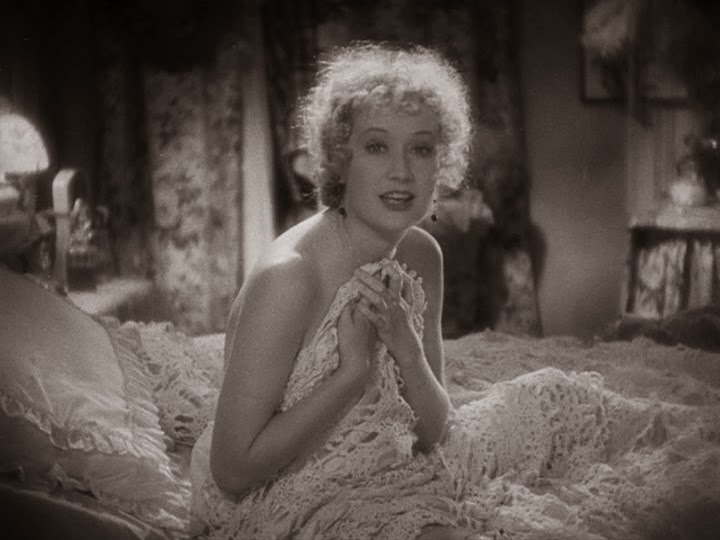
Sunday, 6 October 2013
An early Clint sighting!
Clint in an early (and I think even first) role in Revenge Of The Creature (1955). It's only a about 20 seconds long and is a throwaway gag that Clint's lab technician has assumed that a cat has devoured one of four mice in a cage (thus proving that there's a built in instinct to attack since the cat had been fed recently) - until he finds it in his coat pocket. Goofy, but it ties in somewhat to the rest of the film.
And that is some damn good hair.
October Horror 2013 - Chapter #1
I'm a little late in saying hello to another month of horror viewing, but it's not like I've been sitting on my hands. A few of my early watches will show up on my blind spot later in the month, so I'm just now getting to my first installment. I'll watch horror anytime, but as in past years I love to pack them in during October. Let's start with some of the older classics..
Dr. Jekyll And Mr. Hyde (1931 - Rouben Mamoulian) - It really is high time I see more films by Mamoulian...His use of moving cameras, shadows, point of view shots and quick edits not only greatly enhance the story of a man wrestling with temptation, but also rival many directors 80 years down the road. He also cuts in numerous shots of inanimate objects (statues, boiling cauldrons, burning candles, etc.) to convey emotion, suspense and foreshadowing. As an early sound picture there are still some awkward moments (and a rather disturbing pronunciation of the good doctor's name as "Gee-kull" - though maybe I've been saying it wrong all these years...), but that really only underscores how impressive the rest of the picture is. A great start to my October.
The Picture Of Dorian Gray (1945 - Albert Lewin) - A classic tale told exceedingly well. It's initial 40 odd minutes are more straight drama, but it gives us time to better understand Dorian and those around him, so that when things turn darker there's a real sense of horror. The brief use of colour to show Dorian's portrait is highly effective as is the use of lighting throughout. The most entertaining aspect of the film may be Oscar Wilde's wonderfully cynical, cutting and very funny writing. George Sanders was born to play Lord Henry Wotton and speak words like "To get back my youth, I'd do anything in the world, except get up early, take exercise or be respectable". They roll off his tongue in an effortless biting way that feels so very spot on for something Wilde wrote. My favourite and best bit of nastiness though is spoken by the narrator describing Wotton's view that the hostess of a dinner party had "the remains of a really remarkable ugliness". Ouch.
Revenge Of The Creature (1955 - Jack Arnold) - This follow-up film to The Creature From The Black Lagoon (more on that one as we get to my blind spot at the end of the month) was an obvious attempt to continue to cash in on the creature, and it surprisingly works almost as good as the original. It covers a lot of the same ground (the boat in the amazon, loads of really fine underwater footage, same creature, same blaring music whenever he shows up on screen, the female who needs rescuing, etc.), but moves out of the Amazon fairly quickly and brings the creature back to a marine park for study as well as public viewing. Of course, the creature ain't too keen on the arrangement and manages to cause havoc after he escapes. For a "man in a monster suit" type of film, it's pretty effective as well as fun and the acting/dialogue never slows it down. The "science" is a bit wonky at times, but like its antecedent I appreciate the attempt at using evolution as a core tenet (take that Texas Board of Education!). I also appreciate the attempt to make a strong female character - here the beautiful blonde is an ichthyologist, dives down to do research on the creature and can handle herself in any verbal debate - and also acknowledging (though somewhat awkwardly) the pressure for women to choose between domesticity and a career. As Helen ponders her decisions in life (since many of her classmates are married with kids) there's this exchange with her fellow scientist and new romance Clete:
The assumption that a gal had to choose might be the most horrific part of the picture...
The Creature Walks Among Us (1956 - John Sherwood) - In what I would guess was one more try to squeeze a bit more out of the Creature From The Black Lagoon fans, this third film begins by searching the Everglades for the beast. It's not clear if they are, ahem, rebooting the franchise in U.S. waters or simply searching for the creature of the last film (who appeared to be sinking to the bottom after being shot). Whatever the case, they probably should have stopped at movie number two. It's not terrible - it looks good, the underwater sequences are possibly the best so far and it stretches its story beyond just the monster aspects - but the plot creaks through the wonkiest science so far as the creature gets a tracheostomy so it can begin to use its lungs, spend more time on land and evolve more human characteristics. The story tries to show some of these different characteristics (in contrast to the creature) by setting up three male reactions to the lovely blonde Marcia Barton. Her husband is obsessive and jealous, Jed Grant (a hired hand on their expedition and the study of the caged creature afterwards) is aggressive and predatory and Dr. Morgan is caring and attentive. However, it's all a bit forced and simply doesn't fit very well with the story. The change to the creature (his hands look more human, his top layer of skin has peeled off, he has on human clothes, etc.) reduces the threat and the film loses a lot of steam. In the end, it's still a decent watch though...
Thursday, 3 October 2013
Blindspot - "Lost Weekend" & "Deliverance"
When I chose Lost Weekend and Deliverance as a Blindspot pair, I did it with a vague idea of a common theme of men overcoming major obstacles. As it turns out, the biggest obstacle each central character faces and needs to overcome is staring right back at him in the mirror. That's not to say there aren't a few other hindrances in their way throughout each story (addiction and hallucinations in the first, raging water and crazy backwoods hunters in the other), but each man has to come to the realization that he has worth, courage and the ability to "dig deep". For some, it takes desperate and dire circumstances to finally get the message across.
In Billy Wilder's Lost Weekend, Ray Milland plays Don Birnam - a miserable alcoholic who (even though he has managed 10 days sobriety) continues to be his own worst enemy. We actually meet one of his bottles of rye (hanging out the window in one of the few hiding spots his family haven't found yet) before we meet him. As the camera moves into the apartment, we learn that Don is preparing to go to the country with his brother for a weekend away from all temptation. However, Don has every intention of bringing along some of his favourite refreshment if he can just divert his brother's attention for a few minutes. If he plans to get some writing done, he needs to be creative and he believes that alcohol allows his mind to "toss the sandbags overboard so the balloon can soar". But that's the thing about someone in Don's condition - they can rationalize just about anything and lie as easy as most of us breathe. And not just to his brother or girlfriend (Jane Wyman with the loveliest set of cheekbones you ever did see), but mostly to himself. He may become far more loquacious when liquored up (or "tight" as they used to say in the old days), but he hasn't made a lick of progress on his novel. "Suddenly I'm above the ordinary. I'm confident, supremely confident" he says as he riffs on other supremely artistic people and he may very well feel that way, but Don is far too scared of failure to truly commit to his writing. Hence the booze and the roadblock that is himself.
In John Boorman's Deliverance, Ed (Jon Voigt) seems to have everything he wants (nice job, nice house, nice wife, nice kid - everything "nice"...), but he's somewhat unsure of himself in comparison to his outdoorsman buddy Lewis. One of their early conversations while drifting down the soon-to-be-flooded Cahulawassee River is about why Ed even comes along on these trips. Lewis directly mocks his comfortable life and implies that he has a deep-seated need to break out. Lewis, on the other hand, is always bursting - whether it's scoffing at the idea of insurance or barreling through the deep woods in their jeep to prove to the locals that he can find the river himself. Ed's a bit frightened by this demeanour, but awe-inspired as well. Lewis may be rude and easily disparaging of others, but he outwardly exudes confidence - even if it's more bravado than anything else, it still appeals to Ed. On their first night of camping by the river, Ed and their two other friends have imbibed freely while Lewis remains stone cold sober. The next morning Ed borrows Lewis' crossbow to try some hunting and fails completely as he falls all over the place and misses his target wildly. He seems ashamed of himself and wants to "confess" to Lewis...This opening to their simple paddle-down-the-river-before-it-disappears weekend accomplishes a great deal: it sets up our travelers as disrespectful of these rural people, disrespectful of nature itself and dishonest with themselves.
That dishonesty is Don Birman's biggest issue. It's not that it'll be easy to kick his long term habit if he admitted it, but at least he could see that his drinking is more crutch than creative tool. During his weekend bender that encompasses the film, he does actually take a moment to get down on paper his stories. He's just told his regular bartender that this time he's gonna do it and (after a few drinks to get the juices flowing) he heads back home to pour his words onto the page through his typewriter. But as soon as that blank page stares back at him, he almost immediately reaches for a drink...The cupboard is bare, though, and his scheming to get more commences. It seems the search for the booze is half the addiction and it overwhelms any desire to create his art. The binge starts after he convinces his brother to take Helen to a concert instead of taking the earlier train. They agree to leave him alone and take a later train since he has no access to any money, all hiding places of liquor have been emptied and every nearby bar has been told not to supply him. Of course, the second they leave Don's gears start grinding. He finally finds a stash of money meant for the cleaning lady and bolts to the liquor store and then his favourite bar to celebrate. The bartender gives in since Don assures him that he'll definitely leave at a specific time in order to meet his brother. Don also has some remaining money, so it's an easy sell to the man tending bar. Of course, the drinks pile up while the clock ticks down and Don misses his rendezvous time. His brother leaves without him (fed up with the pain and suffering Don continues to leave in his wake) while Helen begins searching for him. Back alone in his apartment, he uncorks the bottle...
Meanwhile on the Cahulawassee, Ed has switched rowing partners and is paddling now with Bobby (Ned Beatty) - a somewhat annoying and overly condescending businessman. When they pull off to the side of the river, they encounter a couple of local moonshiners who don't take kindly to Bobby's attitude and rolling eyes. Ed tries to diffuse the situation somewhat, but fails again and what follows is one of the more infamous scenes in 70s American cinema. Though the physical abuse Bobby undergoes is hard to watch, the toughest thing about the scene is seeing how he is completely humiliated and dehumanized. Lewis and Drew (Ronny Cox) arrive and help them escape, but the consequences of their actions affect everyone in very different ways. Drew is shattered by what they had to do to escape, Lewis is humbled and Bobby (at least by the end) starts to find goodness in others. In Ed's case, he has to take on a leadership role as the group is pursued and gets caught in the rapids and the rocks. The plot shifts allow for the film to switch gears from an environmental warning tale to a road/river picture to a dark horror to an adventure and finally returns to the tale or warning (respect nature and it'll respect you). Though certainly responsible for many people's view of the "hillbilly south" (the early duelling banjos scene, the mannerisms and speech of the locals, etc.), the film does no favours to the city folk who intrude upon the landscape. It's like the Cahulawassee is hitting back at the "civilized" folks who dare to flood her banks.
Of particular note in Deliverance are the many river navigation scenes. Each paddle is handled and each rapid navigated by the actors themselves. It lends an air of excitement and danger to the film that makes it feel all the more real and visceral. And when Jon Voigt climbs that rock face, Jon Voigt is actually climbing that rock face (no doubt with some extra safety precautions, but still...). Naturalism reigns in this part of the country as it does in the film in style and acting. You can't help but Join Ed on his journey to discovering his hidden ability. Whereas in Lost Weekend, melodrama and artifice are the underpinings. The street scenes and sets (apartment, bar, etc.) look realistic, but the acting, the monologues, the blaring music and the heightened emotion all call attention to themselves. This isn't a bad thing of course - the script is typically sharp and Don's speeches are so very eloquently crafted by Wilder that they are just pure joy to listen to (even if covering depressing or pathetic ground). Ray Milland won an Oscar for his decidedly non-natural performance, but it fits those words and creates one big emotional arc towards his own self-discovery. Two vastly different films reaching for similar conclusions.
Friday, 20 September 2013
TIFF 2013 - Starred Up
There's a special delight in finding that hidden gem at a film festival - not just to lord it over others that they "missed out" (though admittedly that brings a certain sense of pleasure to it), but because it helps to validate the ongoing search for great movies tucked away in corners or buried under the avalanche of big studio marketing product. I suppose it also stokes that obsessive need to watch "everything", but when you start getting that little buzz, that little jolt of realization that you're watching something really damn good when you simply didn't expect it, it's totally worth it.
That was my feeling somewhere around the 45 minute mark of David Mackenzie's Starred Up as everything clicked into place and it dawned on me that I was seeing a great film. Even in my very tired frame of mind at 12:30 in the afternoon (smack dab in the middle of the festival and with four more films to follow that day), I was energized and knew that I was on to something here. As it turns out, Mackenzie's story of a young man who gets moved up to the big boys prison where his father also happens to reside ended up being my very favourite film of the entire festival. There was a palpable sense of authenticity about the story, location (an actual old prison) and characters that kept a semblance of unease throughout the film and brought unpredictability to each and every scene. These extraordinarily flawed individuals could explode at any given moment, but could also surprise via their cunning, logic and occasional ability to see the bigger picture and not just the end of a shiv. The story kept a strong forward momentum, but also provided an ebb and flow in the status of different characters and overall emotion. Never once did I doubt that any of the prisoners had a grab bag of violent tendencies or the capacity to ignore suffering in others, but I also never quibbled when they showed an ability to change, to consider consequences or to think instead of simply reacting. In other words these were fully realized people on screen.
The central focus is 19 year-old Eric, who has just been "starred up" to the adult prison. He may have been a teenager while in juvenile hall, but there's no time for "coming of age" here. He's given his own cell due to "risk" factors and doesn't waste much time in creating a makeshift knife from his toothbrush. His demeanour, expression and body language all show he is always alert and won't wait for trouble to come to him - he'll beat it to the first punch. In his wing of this sprawling prison, just a floor above him, is his father Neville. Though he initially comes across as less physically intimidating, he has power in this particular section of the jail. He knows guards, has wider access to amenities and has his own "crew". Their first conversation in the yard is less family reunion and more about chest thumping warnings, but Neville has a clear message for his boy - be careful who you piss off here. There's a pecking order in prison and Neville reports up to an even higher level prisoner who rules the entire wing from his cell (replete with numerous comforts).
Eric is involved early with an incident and gets on the radar of a volunteer counselor who runs a regular group meeting for some of the more hot-tempered convicts. The interaction of the therapist and his group is one of the many strong points of the film - there aren't any platitudes or easy answers, there's always a step back after good forward progress and respect is earned within the group. Eric sees something of value in the group, but he'll always have impulse and rage issues and struggles to keep his distance from his father (who tries to scuttle any outside influence his son receives), the boss of the wing and the evil warden who is convinced he is and always will be a burden on society. If there's a weak bit in the film it lies with that cliche warden since he is the sole character without any subtlety or complexity. Otherwise, the film is nigh on perfect in its depiction of not just brutal life in the slammer, but of the different ways men desperately crave respect (in all its forms) and the lengths to which they will go to get it.
Thursday, 19 September 2013
TIFF 2013 - Intruders
If you can generalize about a single country's cinema, I think the safest statement you might be able to make is "Korean films blend genres better than anyone else". Whether it's comedic dark crime thrillers, melodramatic heist films or goofy family drama monster movies, Korea's filmmakers seem to have a natural desire (perhaps even a need) to morph genres, combine them or simply blow them apart - sometimes within a single scene. Of course, like any other generalization it doesn't always hold, but it does draw me to their films on a regular basis. Hence my immediate curiosity to see Intruders. Once I realized it was directed by Noh Young-seok (whose previous film Daytime Drinking was one of the best hidden gems from TIFF several years ago), it became a must see.
Like Daytime Drinking, Intruders begins with a young man from Seoul trekking up North by bus to spend some time in the cold and snowy mountainous region of South Korea. While he just wants to get to his friend's currently unused resort to focus on finishing some writing work, he's a bit out of place there and this doesn't go unnoticed by the locals. He manages to grab the attention of a recently released convict who insists on giving directions, providing uncalled for assistance and doing his best to get a good solid drinking session going. The humour is deadpan and is based on the city's guy's baffled reactions to the rural guy's odd yet still friendly behaviour. Unlike the previous film, our city dweller this time manages to avoid too much heavy drinking at the outset, but it's not like he's any better focused. He's a champion procrastinator and keeps finding other ways to waste time and avoid his writing, including traipsing through the woods out back, discovering trapdoors in the woods and running into a bunch of other people - all of whom seem to be just a wee bit off...
But remember this is a Korean movie, so as soon as you think you're getting comfortable with the rhythms, pace and parameters of Intruders (ie. "city boy meets odd country folks" riffing), things might be about the shift on you. And that's certainly what you get after our hopeful screenwriter runs into some "hunters" in the woods. Slowly but surely, more suspense is added as he begins to believe there's a threat around him. He's heard gunshots and footsteps around the little cottage he's in, so when a small group of skiers ask for lodging, he agrees in order to gain some additional protection. His ex-con buddy shows up again as well and through misunderstandings, bad decisions and sudden dark turns in the story, we start wondering who the intruders really are.
The radio and TV are always blaring the latest escalating tension between the North and South (amped up by the U.S. involvement in missile tests), so there's always a sense of unease about things. Noh's use of long takes while two characters converse keeps things feeling spontaneous and this just adds another level of tension. As things go from bad to worse for the writer, a new character shows up, the space under that trapdoor is explored and the suspense continues to rise. Meanwhile that quiet humour keeps popping up in the oddest of places as everyone in the film keeps assuming things about everyone else. As funny as many of the situations are, those assumptions may be a big reason why the writer asks at a low point "Why is this happening to me?". The film succeeds on all levels - it entertains, it engages and it questions. Is it any wonder why Korean cinema is producing some of the most exciting films out there?
Thursday, 12 September 2013
TIFF 2013 - Gravity
The biggest complaint I've heard about Gravity is that it doesn't feel like a film. In other words, it's more like a video game or an amusement park ride than something you would normally see in your local movie theatre. You certainly can't get away from the fact that there are gobs of CGI in it and that there are obvious reality-stretching thrill ride aspects. There are sequences specifically designed to ratchet up the tension to new levels of intensity - so much so that you might still be unclenching your toes hours later. So what's wrong with that you ask? Well, nothing...
Alfonso Cuaron's Gravity (in its non-IMAX 3-D version at least) is a wholly immersive experience. It's sole purpose is to put its two high-priced charming stars into impossible-to-escape scenario after impossible-to-escape scenario upping the ante each time to see if you can hold your breath a few seconds longer and grip that arm rest a little tighter. From that point of view - especially if you enjoy that kind of thing - it's an astonishing success. That aforementioned tension steadily increases from the use of exceedingly long "takes" - a Cuaron trademark, but certainly much more stitched together than ever before here - and a raging score and sound field. It has the effect of dropping you into their desperation and panic without promise of getting out the other side.
When I say "their", I really should qualify that to only Sandra Bullock's character Ryan Stone. She is accompanying a space shuttle crew to perform some of her experiments, but only has about 6 months of training under her belt. George Clooney plays Matt Kowalsky, one of the astronauts who coolly jet packs around the shuttle during the opening spacewalk of the film and stays equally as cool throughout the pandemonium that follows. So Stone's reflexes, ability to calm her breathing and ease with the jet pack are somewhat less than Kowalsky's - which plonks us right there into her space boots (especially when the camera goes in and then back out of her space helmet). Though it took me a few minutes to settle into that opening spacewalk (getting attuned to the 3D surroundings, adjusting to what I felt were a few wonky CGI bits, etc.), I was fully engrossed by the time the first Houston warning of some potential danger came. And then, with still yet a single cut in the film, we're thrown into crisis mode. Though that first 10-15 minute single "shot" is actually composed of hundreds of different pieces, the planning and orchestration of it is a phenomenal achievement.
Of course, that shouldn't mean anything when it comes to your enjoyment of the experience. Did you get sucked in? Did you feel nervous? Were you there with Bullock? That's what Cuaron is trying to do and it worked in spades for me. There are several moments that don't work as well - Bullock's howling with the dogs moment doesn't work and Clooney is just too damn charming sometimes - but for me it was all easily forgiven. The ebbs and flows of tension are timed to give you just enough of a rest - but not too much - before the next wave of crisis arrives. The score is perhaps overpowering at times, but it served its purpose exceedingly well. Like a great amusement park ride you've just been on with your friends, I (and many other people) wanted to get right back in line and do it all over again. I just needed a few extra minutes for my muscles to relax and my toes to get back to normal.
Subscribe to:
Posts (Atom)